Of All the Art Projects You Have Done What Has Made People Roll Their Eyes the Hardest
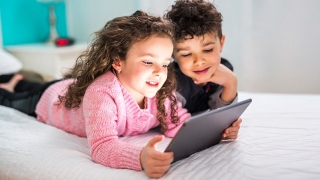 In that location are many reasons to gear up limits on your child'southward screen time: To encourage outdoor play and healthy activeness, to foster healthy sleep habits and to promote in-person social relationships. Eye health is another.
But with more and more of our lives lived in front of screens – whether it's for piece of work, school, entertainment, socialization, or practice – how can parents ready realistic limits and guidelines for their families?
Ayesha Malik, OD, pediatric optometrist at Children's Hospital of Philadelphia (CHOP), helps us empathize the risks of too much screen time on children's vision, and what parents can do to assist their kids exercise good for you habits when they are using screens.
Eye issues caused by excessive screen time
Here are some of the means screen time tin can impact kids' optics.
Middle fatigue
Middle fatigue — called asthenopia — is characterized by eye discomfort, dimness of vision and headache. Asthenopia can exist caused past overuse of the centre, for instance during a period of prolonged focus on a screen. Any glare on the screen tin can further strain the eyes.
Children with eye fatigue may complain of headaches, centre pain, or feeling tired, headaches. They may lose interest in tasks such every bit reading.
Another effect is that kids focus and so intensely on their screens. This prolonged close-focus attention adds to fatigue. "Our eyes need breaks from close-up focus," says Dr. Malik. "Children can lose track of time when they get absorbed."
Dry and irritated eyes
The optics tin can besides become dry and irritated during long stretches of screen apply. Studies show that people of all ages blink far less ofttimes when concentrating on a screen, which in turn causes the eyes to dry. A articulate and stable tear film on the eye surface is essential for clear vision. This trouble can be worse for children who may accept to look up at a screen that's positioned for adult apply.
Loss of focus flexibility
When children's optics stay focused close-up for long periods, they can find it difficult to suit to distance vision afterwards. Generally, that's a curt-term problem, and the eyes adjust back to their normal flexibility.
Nearsightedness
Kids who are on screens are typically indoors. "Exposure to natural daylight is critical to developing optics," says Malik. "Kids need time playing exterior for their wellness, but also for their optics."
Studies have establish that children who spend more fourth dimension indoors are more likely to develop nearsightedness (myopia). The exact procedure is even so being studied, but researchers believe UV light (as long every bit the eyes are protected from intense sunlight) plays an of import role in healthy middle evolution. The charge per unit of nearsightedness in children has increased dramatically in the by 30 years.
Beyond the eyes: impact on sleep and overall health
Screen time tin also disturb kids' sleep. Showtime of all, the exciting content of many video games and movies can current of air a child up when they should be winding down for bed or a nap.
Second, inquiry shows that when computers and similar devices are used in the evening, the bluish lite they emit alters the brain's sleep rhythms. The brain reads the screen light as "daytime" and shifts the body's cyclic rhythm.
The American Academy of Ophthalmology (AAO) contends in that location is currently no scientific bear witness that demonstrates blue light from electronic devices is harmful or damaging to one's optics. Therefore, the AAO does not support the use of "blue calorie-free blocking" lenses.
A better strategy is to practice consequent, healthy habits to protect your kid'southward eyes during screen time. And when it comes to sleep, the best matter you can do is limit screen fourth dimension, particularly in the hours before bedtime. Aim for no devices or screens for one 60 minutes earlier bedtime.
Assist your child exercise skilful eye habits
Most families can't — and don't want to — completely remove screened devices from their children's lives. They're part of living in the modern world. What you tin exercise is protect your child's eyes by teaching them healthy screen time habits.
The 20-twenty-20-two dominion
Since focusing on a "about chore" — such every bit reading, writing or staring at a screen — increases the demand on eyes' microscopic focusing system, eyes need a interruption to reset their focusing systems. Use the "20-20-20-ii dominion." During any concentrated visual task, encourage your child to suspension focus every 20 minutes, focus on something at least 20 feet away for xx seconds, and blink 20 times. This allows the eyes to relax and to render to their natural position and baseline settings. (Adults should utilize this trick too!)
Kids aren't always the best estimate of time, especially when they're engrossed in a game or movie, and so consider using a timer to encourage those breaks.
The final "2" is a recommendation for two hours of outdoor play each 24-hour interval to stimulate the healthy development of the focusing system of children's eyes and ward off nearsightedness.
Screen size and distance
The smaller and closer a screen is, the harder your child's eyes must work to focus on it. If possible, encourage your child to piece of work on a larger screen, such every bit a laptop or desktop computer, rather than a small telephone screen.
Dr. Malik suggests positioning screens at to the lowest degree an arm's length away to minimize eye strain. The screen should exist positioned and so your kid looks slightly down at it, not upward. Consider post-obit the one-2-10 dominion when it comes to screen positioning: Concord phones 1 foot away; sit 2 feet away from laptops and desktops; and encourage children to sit 10 feet away from the television.
Eliminate glare
The more than reflection on your child's computer screen, the harder their eyes must work. Lower the effulgence settings on your kid's computer and other devices (in that location is often a setting that will exercise this automatically) and watch for glare on the screen to ensure comfortable viewing.
Have your child'south eyes examined
Make regular center exams part of your child's routine healthcare schedule. "Your child'south vision is a speedily developing sense," says Dr. Malik. "It deserves screening for problems and timely treatment to ensure best outcomes."
Make certain at minimum your child is getting either the annual vision screening provided at school, or a vision screening at your pediatrician's office during your child'south next well bank check.
Even if your child has a normal vision screening, they can however exist at risk of asthenopia or other center problems. If your child complains of ongoing headaches, dry or irritated optics, or middle pain, it's important to schedule a comprehensive eye test with a pediatric ophthalmologist or optometrist. Different vision screenings, comprehensive eye exams evaluate not only the focusing system of the eye but its structure and overall health, checking for any underlying issues that may manifest during periods of high stress.
For more than helpful data, Dr. Malik recommends this resource from the American Academy of Pediatrics: Give Your Child's Eyes a Screen-Time Break: Here's Why.
Source: https://www.chop.edu/news/health-tip/how-too-much-screen-time-affects-kids-eyes
0 Response to "Of All the Art Projects You Have Done What Has Made People Roll Their Eyes the Hardest"
Post a Comment